Equitable Identification in Aerial Facial Recognition
| Field | Details |
|---|---|
| Domain | Security and Defence / Biometric Surveillance |
| Assurance Goal | Fairness (Demographic Performance Parity) |
Overview
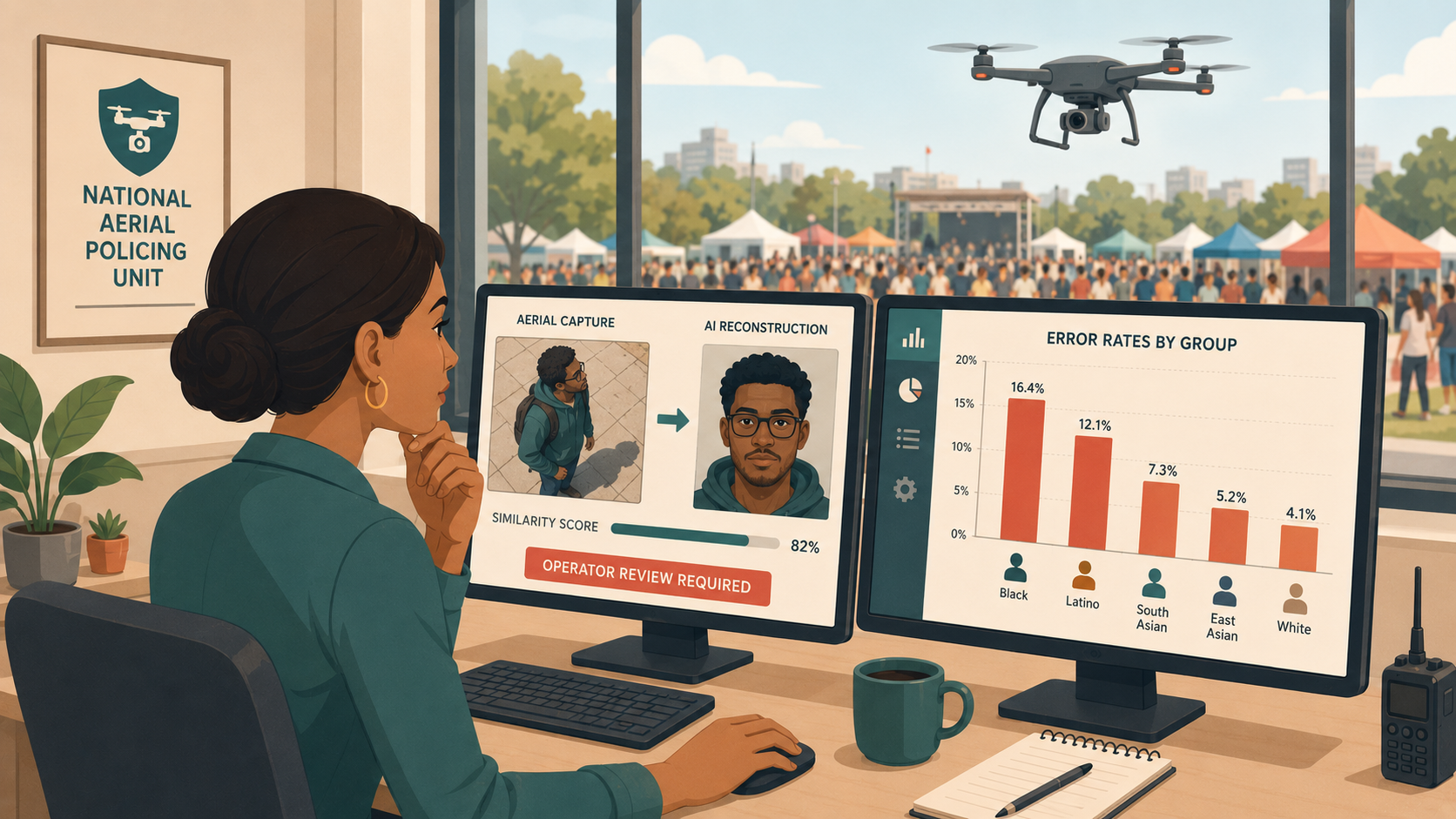
The National Aerial Policing Unit (NAPU) — a fictional composite police and civil-contingencies capability — has developed a prototype facial-recognition framework for drone-based operations. It is intended for three uses: (1) searching for missing persons over wide or difficult terrain, (2) monitoring crowds at large public events for safety and security purposes, and, in a later phase, (3) controlling access to a small number of national infrastructure sites. What distinguishes the framework from a conventional facial-recognition system is that most faces captured by an airborne drone are not looking squarely at the camera. Before an identification decision can be made, a generative AI (GenAI) module, which will be referred to throughout as the “frontalisation module”, creates an approximate frontal-view image (or composite) from the non-frontal, and often distant or oblique, view the drone actually captured. The reconstructed face is then compared against a reference gallery by classifiers running on energy-efficient neuromorphic hardware, chosen because it can perform the comparison at very low power, on board the drone or at a battery-powered ground station.
A note on vocabulary. Frontalisation is the process of synthesising a face-on image from a face photographed at an angle. 1:N (one-to-many) identification means comparing one captured face against many entries in a reference gallery, as opposed to 1:1 verification, which checks a single claimed identity. Neuromorphic hardware refers to chips organised like the brain’s neurons and synapses, storing a model’s learned weights as physical electrical states (the component that makes this possible is the memristor); decisions compute in place, at very low power — suited to a drone’s battery.
NAPU intends to move from prototype to a phased operational pilot, starting with missing-person search operations and crowd monitoring at a handful of major public events first, before extending to site access control afterwards. Before it would approve the pilot, NAPU’s independent ethics advisory board pointed to the Court of Appeal’s judgment in Bridges v Chief Constable of South Wales Police, which found a different force’s use of automated facial recognition unlawful in part because its Equality Impact Assessment failed to engage with the accumulating scientific evidence that facial-recognition systems can misidentify people from some demographic groups more often than others.1 That evidence base is now substantial. For instance, NIST’s own vendor testing has repeatedly found large, algorithm-dependent differences in false-match and false-non-match rates across race, sex, and age groups in widely deployed face-recognition algorithms.2 NAPU’s board was troubled that the framework’s central novelty (i.e. a generative reconstruction step feeding a neuromorphic classifier) has, as far as it could establish, no published demographic evaluation of its own. NAPU has therefore commissioned an assurance case to demonstrate that the framework identifies people fairly across demographic groups before any operational deployment proceeds.
System Description
Reading this section. This is the system you’re building a case about. Aim for a working picture of what it does and where it could go wrong — you don’t need to master every technical detail.
What the System Does
The framework:
- captures aerial imagery of individuals from a drone-mounted camera, frequently from an oblique or elevated angle rather than face-on;
- detects candidate faces within the captured imagery and estimates head pose to establish how far each one departs from a frontal view;
- reconstructs an approximate frontal-view image using a generative adversarial network (GAN) where the estimated pose is too oblique for direct comparison, synthesising plausible detail for parts of the face the camera did not observe;
- encodes the resulting image into a compact identity representation and compares it against a reference gallery using classifiers implemented on memristor-based neuromorphic hardware; and
- returns a ranked candidate match with a similarity score wherever a comparison exceeds a pre-set threshold, for a human operator to review.
The framework does not itself authorise any action. It surfaces a candidate identification for a human operator to accept, reject, or escalate.
How It Works
- Aerial Image Capture: A drone-mounted camera captures imagery of individuals within the monitored area (e.g. a search area for a missing person, a crowd at a public event, or the approach to a controlled site) typically from an elevated, oblique angle and often at range.
- Face Detection and Pose Estimation: Onboard or ground-station software detects candidate faces in each frame and estimates the angle the head is turned or tilted relative to the camera.
- Pose-Conditional Frontalisation: Where the estimated pose departs from near-frontal by more than a set threshold, the frontalisation module reconstructs an approximate frontal-view face, generating pixel content for regions the camera did not directly observe (e.g, the far side of the face in a profile view).
- Identity Feature Encoding: The frontalised image is encoded into a compact numerical representation of facial identity (i.e. an embedding) suited to comparison.
- Neuromorphic Identification: The embedding is compared against a reference gallery, which may include a missing person’s photograph, a watchlist of persons of interest, or an access-control enrolment set. The comparison uses classifiers implemented on memristor-based neuromorphic hardware (i.e. an in-memory, analogue computing approach modelled on biological synapses, chosen for low-power inference suited to onboard or edge deployment).
- Match Scoring and Thresholding: The system returns a ranked list of candidates with similarity scores; only those exceeding a pre-set threshold are surfaced as a potential match.
- Human Adjudication: A trained operator reviews any surfaced match against the source and gallery imagery before any operational action is taken (e.g. a welfare check, an alert, an access decision, or an intervention).
Key Technical Details
| Aspect | Details |
|---|---|
| Capture Modality | Drone-mounted electro-optical camera(s); imagery captured from an aerial, frequently oblique angle, at variable altitude, standoff distance, and lighting |
| Frontalisation Module | A generative adversarial network (GAN) that reconstructs an approximate frontal-view face from a non-frontal captured image, generating pixel content for facial regions the camera did not directly observe |
| Identification Hardware | Energy-efficient neuromorphic classifiers implemented using memristor technology (in-memory, analogue computing that mimics synaptic weights, enabling low-power inference suited to onboard drone or edge deployment) |
| Matching Approach | 1:N identification against a reference gallery with a similarity threshold determining which candidates are surfaced |
| Output | A ranked candidate match (or matches) with a similarity score, flagged for human operator review |
| Training Data | Not specified in the current project description; the demographic composition, pose range, and image-quality profile of the datasets used to train the frontalisation GAN and the classifier are intentionally left open for this assurance case (see Fairness Considerations) |
| Validation | The frontalisation module and the classifier are each validated separately by their respective development teams; no published end-to-end, demographically disaggregated evaluation of the combined pipeline yet exists |
Deployment Context
- Scope: Pilot deployment beginning with missing-person search operations and crowd monitoring at a small number of major public events; access-control use at national infrastructure sites planned as a later phase
- Role: The framework surfaces candidate identifications for a human operator; it does not detain, stop, or act on any individual directly
- Scale: Drone search areas of several square kilometres, or crowds in the low tens of thousands at monitored events
- Users: Police and security personnel operating drones and reviewing flagged matches; a small technical team maintaining the frontalisation and classification models
- Oversight: An internal ethics advisory board reviewing an Equality Impact Assessment; the Information Commissioner’s Office and the Biometrics and Surveillance Camera Commissioner as external oversight bodies
- Status: This case study describes a fictional agency and a plausible pilot scenario, developed from a live research direction in aerial facial recognition using generative frontalisation and neuromorphic classification; it does not report a specific deployed system
Stakeholders
Reading this section. Use this to work out whose concerns your case must answer. Different stakeholders want different things, and a strong case addresses the tensions between them.
| Stakeholder | Interest | Concern |
|---|---|---|
| Members of the Public Captured by Aerial Surveillance | Not being wrongly identified, flagged, or acted upon; general privacy in public spaces | Cannot meaningfully consent to or opt out of being captured; a demographic performance gap means people from some groups carry a disproportionate share of the risk of being wrongly matched |
| Missing Persons and Their Families | Fast, reliable identification during search operations | If frontalisation or identification accuracy is systematically worse for some demographic groups, missing people from those groups may be harder for the system to find |
| Drone and Ground-Station Operators | A workable, defensible basis for deciding whether to act on a flagged match | A similarity score alone does not reveal whether an elevated false-match rate for a particular demographic group makes a given flag less trustworthy |
| NAPU Leadership | A credible operational capability that withstands legal and public scrutiny | Reputational and legal exposure to an Equality Act challenge, as in Bridges, if demographic bias evidence is not addressed before deployment |
| Minority Ethnic Communities and Advocacy Groups | Not being disproportionately misidentified, surveilled, or stopped | Well-evidenced literature shows face-recognition systems commonly perform less accurately for some ethnic groups and for women; a novel generative reconstruction step adds an unevaluated further source of disparity |
| System Developers (Frontalisation and Classifier Teams) | Demonstrating a working, exportable novel capability | The two components are typically developed and benchmarked separately; end-to-end, demographically disaggregated evidence for the combined pipeline does not yet exist |
| Regulators and Oversight Bodies | Lawful, proportionate, non-discriminatory use of biometric surveillance | Whether the Equality Impact Assessment and Data Protection Impact Assessment properly engage with demographic performance evidence, rather than asserting compliance in general terms |
| Event Organisers and Site Operators | Effective, proportionate safety and security monitoring without undue legal or reputational risk | Liability if the system disproportionately misidentifies attendees or visitors from particular demographic groups |
Regulatory Context
Reading this section. Background on the rules the system operates under. Focus on the shape of the constraints, not the regulatory detail — you’re not being asked to argue full compliance here.
Biometric surveillance in the UK sits under several overlapping frameworks, and a reader new to the area does not need all of it to follow this case. What matters is the shape of the obligations these frameworks place on a system whose central novelty (i.e. generative frontalisation feeding a neuromorphic classifier) has no settled track record. Four are worth setting out:
- The Public Sector Equality Duty (Equality Act 2010, s.149). Public bodies must have due regard to the need to eliminate discrimination and advance equality of opportunity when exercising their functions. Bridges establishes that this requires actively engaging with evidence of demographic bias in a facial-recognition system, not merely assertin g that the system is unbiased.
- UK GDPR and the Data Protection Act 2018. A facial image used to identify someone is biometric data, a special category of personal data. The Information Commissioner’s Office requires a lawful basis and an Article 9 condition before it may be processed for identification, and a Data Protection Impact Assessment before deployment — an assessment Bridges found the comparator force had not properly completed.
- The Surveillance Camera Code of Practice (Protection of Freedoms Act 2012). Sets out principles of necessity, proportionality, and transparency for camera-based surveillance in public spaces, overseen by the Biometrics and Surveillance Camera Commissioner. Compliance is encouraged rather than certified, but the Code’s principles shape what a defensible deployment looks like.
- The Human Rights Act 1998 (Article 8, ECHR). Bridges also found the deployment it examined was not “in accordance with law” because too much discretion was left to individual officers over where and whom to target — a finding with direct bearing on any system whose accuracy, and therefore its practical intrusiveness, varies unpredictably by demographic group.3
Fairness Considerations
Reading this section. These are the specific risks the design raises, and will help you identify the claims your case will need to make and defend.
The considerations below are specific to a two-stage pipeline in which a generative reconstruction step sits ahead of the classifier that actually makes the identification decision.
1. Demographic Performance Differentials Are a Well-Evidenced Baseline Risk, Not a Hypothetical One
NIST’s demographic-effects testing of face-recognition algorithms found substantial, algorithm-dependent differences in false-match and false-non-match rates across race, sex, and age groups. In some algorithms, false-match rates for particular demographic groups were found to be orders of magnitude higher than for others.2 Critically, NIST also found that not every algorithm exhibits this pattern, and that the size and direction of any gap is specific to the system tested. The assurance case cannot treat fairness as established by citing this literature; it must treat the literature as the reason a system-specific, disaggregated evaluation is required.
2. Does the Frontalisation Step Itself Introduce or Amplify Bias?
A GAN frontalisation module invents pixel content for parts of the face it never observed. If its training data under-represents some demographic groups, its reconstructions for those groups may be systematically less faithful (i.e. more “hallucinated,” less identity-preserving), which could depress identification accuracy for exactly the groups least represented in training, independently of anything the classifier does. This is not a speculative concern.Research on GAN behaviour under imbalanced training data has found that generative models can collapse toward majority-group modes and amplify racial bias present in their training distribution, with documented real-world analogues in commercial image-generation tools.4 Because the frontalisation module actively synthesises new content rather than merely classifying existing pixels, bias can be introduced here even if the downstream classifier is itself demographically balanced, which is why isolating this stage’s contribution matters.
3. Aerial Capture Conditions Compound Image-Quality Effects
Aerial imagery is inherently oblique, often taken at range, and subject to variable altitude and lighting. This is [recisely the low-quality probe conditions that published research has found widen demographic accuracy gaps in 1:N facial identification, with the size of the widening itself varying by which demographic split is examined.5 Because frontalisation is only invoked for non-frontal poses, the population subjected to the pipeline’s hardest case may not be demographically uniform. And, whether frontalisation is invoked more often, or with lower reconstruction fidelity, for some demographic groups is itself a question the case needs to answer, not an assumption it can make either way.
4. Compounding Effects Across a Two-Stage Pipeline
The frontalisation module and the neuromorphic classifier are typically developed, trained, and benchmarked separately, often by different teams against different datasets. A fairness evaluation of the classifier alone — tested on real frontal images — says nothing about its performance when its actual operational input is a synthetic reconstruction whose fidelity itself varies by demographic group. The memristor-based hardware adds a further, less-studied variable. Analogue in-memory computing is known to be susceptible to device-to-device hardware variability that can perturb a model’s learned weights. This is a plausible failure mode worth investigating, rather than an established and known risk, and the assurance case should be explicit about which of its claims rest on evidence and which rest on this kind of reasoned suspicion.
5. The Two Use Cases Weight Errors in Opposite Directions
For missing-person search, a false negative (i.e. failing to match a person who is present in the gallery) can mean a vulnerable person is not found. Here, recall (true positive rate) parity across demographic groups is what matters most. For watchlist matching at a public event or an access-control point, a false positive (i.e wrongly flagging someone as a match) can lead to a wrongful stop or intervention, echoing the exact concern raised in Bridges; precision (false positive rate) parity is what matters most there. Because the same framework is used for both purposes, the assurance case must be explicit about which error type, for which use case, its fairness claim is controlling for — a single aggregate accuracy figure cannot answer both questions at once.
Assurance Focus
Reading this section. This frames the core question your case must answer. Use the Deliberative Prompts to interrogate the system and find where the argument is hardest.
The assurance case is built around a single top-level goal:
The framework identifies individuals with acceptably equivalent accuracy across demographic groups.
Stated this concisely, the goal exposes its own central question — the word acceptably. No two demographic groups will ever show byte-for-byte identical error rates, so equivalent cannot mean identical; it means a defined and justified tolerance on specific error-rate differences, not equality on every conceivable metric at once. In a complete case, a justification node would state that tolerance criterion, the metric(s) it applies to, and on whose authority it was set.
Fairness is the primary goal. Transparency about how a frontalisation and matching decision was reached is a supporting claim, developed through the argument, rather than a separate top-level goal.
Deliberative Prompts
- Does the GAN-based frontalisation step itself introduce or amplify demographic bias (e.g. by reconstructing facial detail less faithfully for groups under-represented in its training data)? How would you gather evidence to isolate that effect from bias already present in the identification classifier?
- Missing-person search rewards catching every true match (high recall); watchlist and crowd-monitoring use rewards avoiding wrongful flags (high precision). If the two error types are not equally distributed across demographic groups, and the same framework serves both purposes, whose harm should the acceptability threshold be set to protect?
- Following Bridges, a UK public body deploying facial recognition is expected to grapple with demographic bias evidence before deployment, not after a complaint. What would count as “having grappled with it” for a system whose central novel component has, as far as we are aware, no published demographic evaluation of its own?
- The frontalisation module and the identification classifier are separate components, likely developed and benchmarked by different teams against different data. If each component’s fairness is separately judged acceptable, does that establish that the combined pipeline is fair, or does the composition itself need its own evidence?
- If credible evidence emerged that reconstruction fidelity was worse for one demographic group, what would be an adequate response: retrain the frontalisation model, restrict the use case, publish the disparity and continue, or withdraw that use case? Who has the authority to make that call?
Suggested Strategies
Reading this section. Candidate ways to structure your argument. You don’t have to use them, but they’re a useful scaffold . Pick one (or combine a few) and develop it.
S1. Argument Over End-to-End Demographic Performance Parity
Establish, through disaggregated evaluation of the combined pipeline (not each component’s isolated benchmark), that identification accuracy is acceptably equivalent across defined demographic groups, using a metric matched to each use case’s dominant error type: false-negative rate parity for missing-person search, false-positive rate parity for watchlist and access-control matching. The argument fails if only component-level, not end-to-end, evidence exists.
S2. Argument Isolating the Frontalisation Step’s Contribution to Bias
Show, through component-level and ablation testing,6 whether demographic performance differentials originate in the frontalisation module, the classifier, or their interaction. This way, any disparity found under S1 can be attributed to a specific stage and mitigated at source, rather than patched downstream without understanding its cause.
S3. Argument Over Training Data Representativeness
Demonstrate that the datasets used to train both the frontalisation GAN and the identification classifier adequately represent the demographic groups, pose ranges, and aerial or oblique capture conditions the framework will encounter operationally, and document candidly where they do not.
S4. Argument Over Governance, Transparency, and Redress
Establish that the fairness evidence has been reviewed by an accountable body, and informed by a properly reasoned Equality Impact Assessment. Show that relevant findings from system evaluations are communicated honestly to oversight bodies and affected communities, and that there is a route to challenge or trigger review of an operational decision believed to reflect biased identification.
Recommended Techniques for Evidence
Reading this section. Methods that could supply the evidence your claims need. Match techniques to the claims you’re making, rather than gathering evidence for its own sake.
The following techniques from the TEA Techniques library may be useful when gathering evidence for this assurance case:
- Equal Opportunity Difference — Quantify the gap in true positive (correct match) rates between demographic groups — the recall-parity question the missing-person use case turns on — giving S1’s tolerance criterion a concrete number to be measured against. The watchlist side’s false-positive differentials come from the same subgroup-disaggregated evaluation, reported via Model Cards below
- Embedding Bias Analysis — Examine the identity-embedding space produced immediately after frontalisation and before the classifier, to check whether reconstructed faces from different demographic groups cluster in geometrically distinct or systematically distorted regions — the most direct way to test whether the frontalisation step itself is introducing bias, independent of the classifier (S2)
- Sensitivity Analysis for Fairness — Perturb pose angle, capture distance, and lighting condition — the aerial-specific variables that trigger frontalisation — while holding identity constant, to isolate whether performance differentials trace to the frontalisation step’s reconstruction fidelity for a given demographic group, rather than to the classifier or the source imagery (S2)
- Datasheets for Datasets — Document the demographic composition, pose distribution, and image-quality characteristics of the datasets used to train the frontalisation GAN and the classifier separately, surfacing likely under-representation (for example, of aerial, oblique, or low-resolution imagery for some demographic groups) before it is discovered operationally (S3)
- Model Cards — Report subgroup-disaggregated accuracy for the combined pipeline (not each component’s benchmark in isolation), its intended use cases, and known limitations, so that oversight bodies and operators are not relying on a single aggregate accuracy figure (S1, S4)
Further Reading
- NIST: Face Recognition Vendor Test (FRVT) Part 3 — Demographic Effects (NISTIR 8280) — The canonical evidence base for demographic performance differentials in face recognition
- NIST: Face Recognition Vendor Test (FRVT) Part 8 — Summarizing Demographic Differentials (NISTIR 8429) — NIST’s more recent synthesis of demographic-effects testing across vendors
- R (Bridges) v Chief Constable of South Wales Police, EWCA Civ 1058 (2020) — The leading UK case on facial recognition, the Public Sector Equality Duty, and demographic bias evidence
- ICO: Facial Recognition Technology (FRT) and Surveillance — Current ICO guidance on lawful processing for facial recognition
- Zulfikar, W., Santy, S., Dambekodi, S., & Dash, T. (2018). A Study on the Use of Boundary Equilibrium GAN for Approximate Frontalization of Unconstrained Faces to Aid in Surveillance — An example of GAN-based frontalisation research aimed explicitly at surveillance use cases, illustrating the kind of technique this framework’s frontalisation module resembles (the paper does not itself evaluate demographic bias)
If AI fairness is new to you, the following are good places to start:
- Barocas, S., Hardt, M., & Narayanan, A. (2023). Fairness and Machine Learning: Limitations and Opportunities. MIT Press — The standard textbook on fairness in machine learning, free to read online; Chapter 1 is an excellent standalone introduction
- Buolamwini, J., & Gebru, T. (2018). Gender Shades: Intersectional Accuracy Disparities in Commercial Gender Classification. Proceedings of Machine Learning Research, 81 — The canonical demographic audit of commercial facial-analysis systems, and a model of how to evidence a disparity claim
- Mehrabi, N., Morstatter, F., Saxena, N., Lerman, K., & Galstyan, A. (2021). A Survey on Bias and Fairness in Machine Learning. ACM Computing Surveys, 54(6) — A widely used survey of where bias enters ML systems and how the main fairness definitions relate
- Leslie, D. (2019). Understanding Artificial Intelligence Ethics and Safety. The Alan Turing Institute — Practical guidance on fairness (among other values) for AI in the UK public sector — the deployment context this case study sits in
- Friedman, B., & Nissenbaum, H. (1996). Bias in Computer Systems. ACM Transactions on Information Systems, 14(3) — The classic pre-ML taxonomy of preexisting, technical, and emergent bias; a reminder that none of these questions started with deep learning
Footnotes
-
R (Bridges) v Chief Constable of South Wales Police [2020] EWCA Civ 1058. The Court of Appeal held that South Wales Police’s Equality Impact Assessment was “obviously inadequate” and that the force had therefore failed to discharge the Public Sector Equality Duty under s.149 of the Equality Act 2010, alongside separate findings that the deployment was not “in accordance with law” for the purposes of Article 8 of the European Convention on Human Rights and that the force’s Data Protection Impact Assessment was deficient. Full judgment: https://www.judiciary.uk/wp-content/uploads/2020/08/R-Bridges-v-CC-South-Wales-ors-Judgment.pdf ↩
-
Grother, P., Ngan, M., & Hanaoka, K. (2019). Face Recognition Vendor Test (FRVT) Part 3: Demographic Effects. NISTIR 8280, National Institute of Standards and Technology. https://doi.org/10.6028/NIST.IR.8280 ; and Grother, P. (2022). Face Recognition Vendor Test (FRVT) Part 8: Summarizing Demographic Differentials. NISTIR 8429, National Institute of Standards and Technology. https://pages.nist.gov/frvt/reports/demographics/nistir_8429.pdf . Both reports find that demographic effects vary substantially by algorithm — some tested algorithms show minimal differentials — which is precisely why a system-specific evaluation, rather than an appeal to the literature in general, is required here. ↩ ↩2
-
The EU AI Act does not apply to a UK-only deployment, but it is a useful comparator for how seriously a comparable jurisdiction treats this category of use: it treats real-time remote biometric identification in publicly accessible spaces by law enforcement as presumptively prohibited, with narrow exceptions that include the targeted search for missing persons — one of this framework’s three intended use cases. That a use this system is built for sits inside the EU’s narrowest carve-out from an otherwise near-total prohibition is a useful marker of the level of justification such use is generally expected to require, even though the Act itself does not bind NAPU. ↩
-
Maluleke, V. H., Thakkar, N., Brooks, T., Weber, E., Darrell, T., Efros, A. A., Kanazawa, A., & Guillory, D. (2022). Studying Bias in GANs through the Lens of Race. In Computer Vision – ECCV 2022. https://doi.org/10.1007/978-3-031-19778-9_20 ↩
-
Bhatta, A., Pangelinan, G., King, M. C., & Bowyer, K. W. (2024). Impact of Blur and Resolution on Demographic Disparities in 1-to-Many Facial Identification. IEEE Winter Conference on Applications of Computer Vision (WACV). https://arxiv.org/abs/2309.04447 . The paper finds that increased blur and reduced probe resolution significantly increase false-positive identification rates, and that the size of the resulting demographic gap differs by which grouping is examined (the paper compares male/female and African-American/Caucasian splits) — evidence that image-quality effects and demographic effects interact in ways that are not straightforward to predict in advance. ↩
-
Ablation testing removes or disables (“ablates”) a part of a system to measure how performance changes without it. Here, that might mean running identification with the frontalisation module switched off (comparing the raw non-frontal capture directly) or replaced by a simple geometric transform, and observing how accuracy changes. Note the difference from other perturbation techniques, which vary a model’s inputs (e.g. pose, blur, lighting) and watch the output. Ablation intervenes on the system itself, changing or removing parts of the model or pipeline directly. That is what lets it attribute an observed disparity to a specific stage, rather than to the conditions the system was given. ↩