About the Trustworthy and Ethical Assurance Platform
The Trustworthy and Ethical Assurance (TEA) platform is an open-source and community-oriented set of resources, which has been designed and developed by researchers at the Alan Turing Institute and the Centre for Assuring Autonomy (University of York) to support the process of developing and communicating trustworthy and ethical assurance cases.
To better understand the purpose and motivation of the TEA platform, consider the following question.
Question
How should a project team provide assurance to their stakeholders or users that some ethical principle, such as explainability or safety, has been upheld across the full lifecycle of designing, developing, and deploying a data-driven technology?
This is not an easy question to answer! As we pick it apart, we realise there are many more questions that need to be addressed:
- Which ethical principles are relevant to the technology (e.g. fairness, explainability, safety, sustainability)?
- How are these principles defined in the context of the project?
- How can a project team provide justified evidence to their stakeholders or users that these principles have been upheld?
- Who should be engaged as part of this process, and how should this engagement be managed or structured?
What does the TEA Platform do?
The TEA platform helps multi-stakeholder and multi-disciplinary teams—including researchers, developers, decision-makers, managers, auditors, regulators, and users—answer these questions in a systematic manner. It achieves this through three interlocking features:
- The TEA Case Builder: an interactive tool for developing assurance cases (accessible here )
- The TEA Curriculum: a structured set of modules and resources that help users get the most out of the tool (see curriculum)
- The TEA Community: our community infrastructure that promotes open and collaborative practices, such as the sharing of argument patterns and plugins (see community resources)
1) The TEA Tool: An Interactive Tool for Developing Assurance Cases
The main component of the TEA platform is the interactive tool that allows members of a project team to iteratively develop an assurance case (see Figure 1) using a graphical interface.
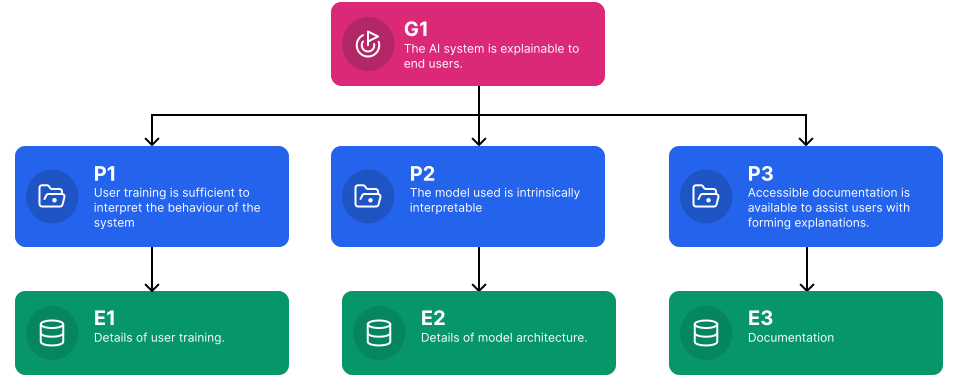
Figure 1. A simple assurance case showing a top-level goal claim, a set of three property claims, and corresponding evidence.
At the top of an assurance case is a clear and accessible claim about the goal of the technology or system in question (i.e. the goal claim). Underneath this goal claim is a set of additional claims about specific properties of the project or system (i.e. property claims), which help specify the goal and demonstrate what actions or decisions have been taken to achieve the goal. And, at the base of the assurance case is the evidence that justifies the validity of the above claims.
In short, an assurance case presents a structured argument, in a logical and graphical format, about how an ethical goal has been achieved.
An Introduction to Trustworthy and Ethical Assurance
A more complete introduction to Trustworthy and Ethical Assurance can be found in our curriculum section.
2) The TEA Curriculum: Skills and Training Resources
Although the logical structure of an assurance case may be simple, the process of developing an assurance case can be complex. As such, a significant element of the TEA platform is our skills and capability-building resources that have been designed to widen the scope of who can participate in the assurance ecosystem.
Skills and Capabilities Resources
You can browse our curriculum or technical documentation to find out more.
3) The TEA Community: An Open and Collaborative Community Infrastructure
The TEA platform is designed to support open and collaborative practices. As our collective understanding of trustworthy and ethical assurance evolves alongside emerging technologies like AI systems and digital twins, it is vital that the process of developing and communicating assurance cases is done in a way that enables knowledge sharing and community engagement.
The platform supports this through several key features:
Sharing and Discovering Assurance Cases
The Discover section of the platform allows users to browse and explore publicly shared assurance cases and argument patterns. This enables teams to:
- Learn from exemplary assurance cases developed by others
- Find and adapt reusable argument patterns for common assurance challenges
- Share their own work to contribute to community best practices
Collaboration Features
The Case Builder includes built-in collaboration tools to support team-based assurance case development:
- Comments: Add comments to specific elements within an assurance case to discuss evidence, flag concerns, or suggest improvements
- Sharing controls: Manage who can view, comment on, or edit your assurance cases
For broader discussions about the platform, methodology, or community initiatives, visit our GitHub Discussions .
Plugins and Extensions
Coming Soon
Support for community-developed plugins is planned for a future release. Plugins will allow users to extend the platform’s functionality with custom components, integrations, and argument pattern templates.
Funding Statements
- The ongoing development and maintenance of the TEA platform is supported by the Alan Turing Institute.
- From October 2024 onwards, the project will receive support as part of the EPSRC Networks of Cardiovascular Digital Twins (CVD-Net) programme (awarded to Professor Steven Niederer, EP/Z531297/1)
- From March 2024 until September 2024, the project was funded by the BRAID (UKRI AHRC) programme as part of a scoping research grant for the Trustworthy and Ethical Assurance of Digital Twins project, which was awarded to Dr Christopher Burr.
- Between April 2023 and December 2023, this project received funding from the Assuring Autonomy International Programme, a partnership between Lloyd’s Register Foundation and the University of York, which was awarded to Dr Christopher Burr.
- Between July 2021 and June 2022 this project received funding from the UKRI’s Trustworthy Autonomous Hub, which was awarded to Dr Christopher Burr (Grant number: TAS_PP_00040).
Collaborators and Partners